.png)
Hellstrips
I recently drove by a traffic island planting we designed, installed last year by a wonderful Boy Scout for his Eagle Scout project, and I did a double take. It's a rough spot, a traffic island in the middle of a busy street leading into a State Park, in full sun, hit with road salt all winter, with some debris from traffic. And it's thriving (I'm for sure not taking credit for the thriving, but am patting myself on the back for plant choices!):
Here is the complete list of plants we selected for this hellstrip, each chosen specifically for its ability to handle the rough conditions of life on a traffic island:
 | BUTTERFLY MILKWEED, Asclepias tuberosa Delightful vibrant orange blooms atop deep green foliage. The ecological value cannot be stressed enough, the nectar produced by the butterflyweed is high value. 2' tall. |
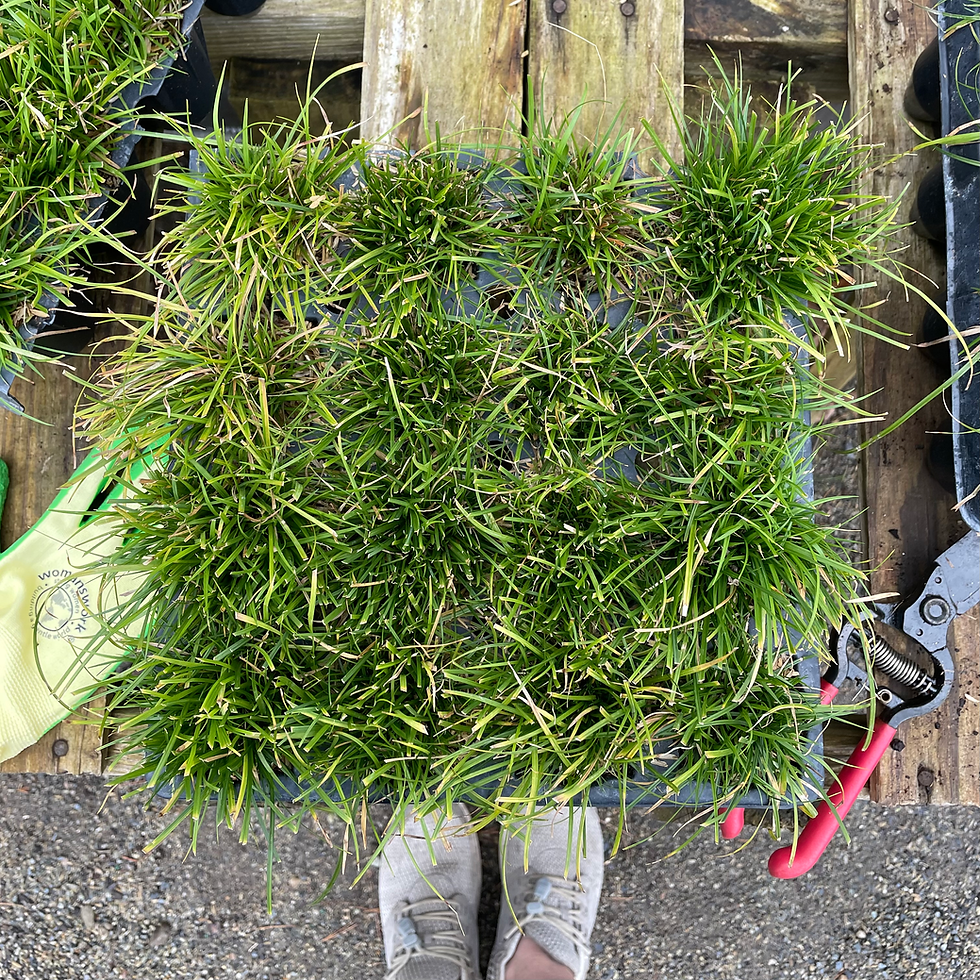
 | PLANTAIN PUSSYTOES, Antennaria plantaginifolia Use this low maintenance plant as a lawn alternative in the harder to grow areas, and enjoy the drought and salt tolerant ease. 12" tall. A Blue Stem favorite! |
 | GRAY GOLDENROD, Solidago nemoralis Short and lovely goldenrod often found in disturbed areas, which gives it its other common name “old field goldenrod”. However, these showy yellow wand-like flowers with gray-green stems and leaves are dynamic in a garden setting. |
 | PALE BEARDTONGUE, Penstemon pallidus* Grows in well-drained, sandy, or gravelly soils, making it an excellent choice for xeriscaping or rocky garden beds. Its tall, upright habit features clusters of tubular, pale lavender-pink flowers that bloom from late spring to early summer. |
 | EASTERN PRICKLY PEAR CACTUS, Opuntia humifusa One would not expect to have a native species of cacti in New England, but the Eastern prickly pear is precisely that! This low growing cactus has wide paddles covered in the requisite spines, large yellow blossoms are followed red fruit. |
 | SMALL YELLOW WILD INGIGO, Baptisia tinctoria The sturdy shrub-like stems produce multitudes of cream-yellow flowers in the late spring, and once established in the garden can handle fairly harsh conditions. |
(*In the hellstrip photos at the beginning, you'll see the not-quite-native Penstemon digitalis. Some of the plants had to be sourced from a specific grower linked to the state and that's what they had. We recommend Penstemon pallidus, pale beardtongue, instead — a true New England native.)
I hadn't heard the term 'hellstrip' until I moved to New England from the Midwest. Much like I hadn't heard of a 'rotary' either. Back home, those are roundabouts. The first time someone told me to turn left at the rotary, I genuinely thought, 'Oh, do they have a Rotary International chapter here?' They do not. But I digress.
New England roadsides may just be one of the more challenging areas to plant. The requirements look like a nightmare job posting. Wanted: Low-maintenance blooming plants that don’t grow too tall and need little care to establish. Must be able to tolerate the following conditions:
Higher than average heat as radiated from the asphalt roadways and pollution from vehicles, dry, nutrient-deprived, sandy soil which is often hard packed, half of the year you will experience drought, the other half you will be covered with mountains of snow and will often have salt winged over you. You need to be attractive, not weedy, and you can’t grow too tall so as to block the view of drivers. You may need to respond well to periodic mowing, self-seeding is a plus. Compensation from pollinators commensurate with experience.
Planting a hellstrip brings beauty to a spot that would otherwise be compacted soil with weeds growing willy-nilly, or someone's doomed attempt at turf grass that was almost certainly never going to succeed. Some communities even come together to plant hellstrips in a coordinated way, turning a string of these forgotten patches into green corridors that connect neighborhoods.
If you are up to the challenge, here are additional native plants that have all passed our “most likely to succeed” criteria. Best of Luck!
 |  | Solidago sempervirens usually 2' in poor soils Salt tolerant, bright yellow fall blooms | |
 |  | ||
 |  | ||
 |  | ||
 |  | ||
 |  | ||
 |  |
Happy planting!
Britt