top of page

Blog Post

Growing Seedlings at Blue Stem


By mid-February, we start warming a small section of our greenhouse to get a jump start on the season. We don’t have a heated greenhouse, so instead we section off an area and use warming mats and a small heater as needed—just enough to take the chill off.


We loosely follow the end of the “Persephone Period.” In Massachusetts, from November through mid-February, daylight drops below ten hours a day, which essentially halts plant growth. Rather than setting up extensive grow lights to artificially extend the day, we wait to start seeds until natural daylight increases. This timing varies depending on where you are in the world. "To explain seasonal changes, the ancient Greeks told the story of Persephone, goddess of the Spring, who was abducted by Hades and taken to the underworld. Her mother Demeter, goddess of Agriculture, was filled with grief and neglected the earth, creating a famine. Zeus interceded with Hades and negotiated Persephone's return. However, since she had eaten four pomegranate seeds, she has to stay in the underworld for four months each year. During that time Demeter mourns her daughter's absence, causing the earth to enter a period of dormancy when nothing grows until Persephone's return."


Our seeds overwinter in refrigerators instead of outdoors. Because we grow over 20,000 plants each year, this system helps us stay organized and consistent, without having to account for increasingly unpredictable winter conditions. Our approach has evolved a lot over the past six years as we learn what works—and what doesn’t. As with most things in growing, you’ll find that every grower does it a little differently!


Lessons from years one and two: what we wouldn’t do again

Sand crusted and hardened on the surface, making seedling emergence difficult. It’s also unsustainable and made trays too heavy.
At scale, outdoor stratification was inconsistent and highly dependent on winter conditions. Year two was especially dry, resulting in low germination.
Starting seedlings in flat trays and transplanting them one by one into larger pots led to leggy, stressed plants.
Complicated lighting setups aren’t needed if seedlings are started at the right time, and they make watering and management harder.


New and Improved methods:

Our seeds spend their “winter” in the refrigerator, nestled in damp—but not wet—vermiculite. This mimics natural cold stratification while giving us much more control than leaving seeds outdoors. We store the seeds in plastic bags with the air pressed out, which helps maintain consistent moisture levels without letting the vermiculite dry out or become waterlogged. This method keeps conditions stable and predictable, regardless of how variable the winter weather may be outside.

We built this small greenhouse inside our larger greenhouse. It gives us just enough heated space to grow what we need without investing many thousands of dollars to heat the entire structure. It’s also a more sustainable approach than heating such a large space.


Beginning in mid-February, seeds come out of the refrigerator and are ready to be sown. We start them in our 200-cell trays, which hold 200 individual cells in a standard 10” × 20” tray. These small cells allow us to start a large number of plants in a relatively small amount of space, making the most of our limited heated area early in the season.
Sedge species are soaked for 24 hours before sowing, and we’ve found this results in much better germination than using non-soaked seeds. The soak helps fully hydrate the seed and can soften the seed coat, making it easier for the seed to break dormancy and sprout once planted.
Instead of heating the entire greenhouse, we use heat mats on our tables to warm the soil directly. This targeted approach uses significantly less electricity than running space heaters and provides consistent bottom heat right where seedlings need it most to germinate and establish strong roots.
At the same time, we switched to 200-cell trays, which allows us to grow more plants in the same footprint and make the most efficient use of our limited heated area.


We originally sowed thickly as a way to save space, but quickly realized that many native plants actually prefer growing this way. Time and again, the data we tracked showed that denser sowing resulted in fuller, greener plants that established more quickly and grew more vigorously, especially in the early stages of growth.
We sow heavily and divide later if needed, allowing seedlings to grow together early on. Even at the point of sale—once plants are potted into quart pots—you’ll typically find multiple plants per pot, which helps create a fuller planting and supports stronger early establishment in the garden.


Native plants usually don’t need fertilizer, but when they’re grown in small cells, they benefit from a light boost of nutrients. We use a very diluted Neptune’s Harvest fish and seaweed fertilizer and apply it through bottom watering, allowing the trays to absorb what they need without encouraging excessive top growth or weak, leggy plants.
Seedlings grow quickly in the mini greenhouse and don’t stay there long before they’re ready to be moved into larger cells. Because our warm space is limited, we start seedlings on a rotating schedule, moving trays along as they outgrow the space so new seeds can take their place.


We use a homemade wooden dibbler to make uniform planting holes for our 200-cell seedlings. Having evenly sized holes speeds up the potting process and helps ensure each seedling is set at the proper depth, making the work faster and more consistent.

We pop seedlings out of the 200-cell trays and pot them up into 50-cell trays as the next step in their growth. While this does add an extra step to the process, our space limitations and unpredictable spring weather make this the most reliable way to keep plants healthy and moving forward.
Some species, like this Asclepias incarnata (rose or swamp milkweed), thrive with just one or two seedlings per cell. These plants establish strong root systems quickly and don’t benefit from being crowded, so giving them a bit more space early on leads to healthier growth as they mature.
As seedlings move into larger cells, some are divided into individual plants while others are left grouped with multiple seedlings per cell. This flexibility allows us to respond to how each species grows, and we can separate or divide them at any stage during the potting-up process if needed.
We add tiers in the mini greenhouse to maximize the available warm space, allowing us to fit more trays inside. During cold snaps, we pack trays in closely to help protect plants from freezing overnight and make the most of the heat we’re generating.
Once days warm up a bit, trays take field trips into the larger greenhouse during the day and then get packed back in at night. By then, the mini greenhouse is full, with trays squeezed into every usable space to avoid freezing.
In late March or early April, seedlings in 50-cell trays are ready to move out of the lightly heated mini greenhouse and into the larger, unheated greenhouse. By this point, increasing daylight and milder daytime temperatures allow the plants to continue growing without supplemental heat.


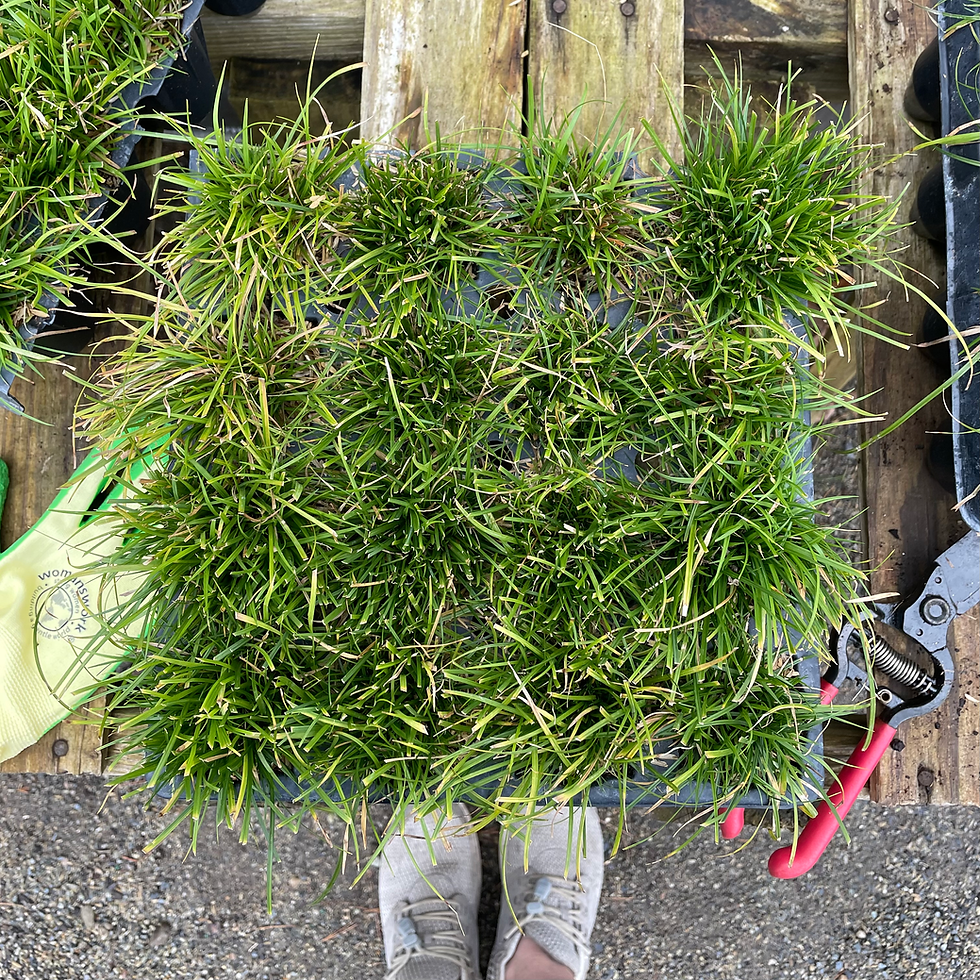
When moving from 50-cell trays into quart pots, you’ll see there are still multiple seedlings per cell. Since customers often buy a single plant, this means they’re actually getting multiple plants in one pot. This helps create a fuller planting early on, and over time one seedling may naturally outcompete the others as the plant matures.


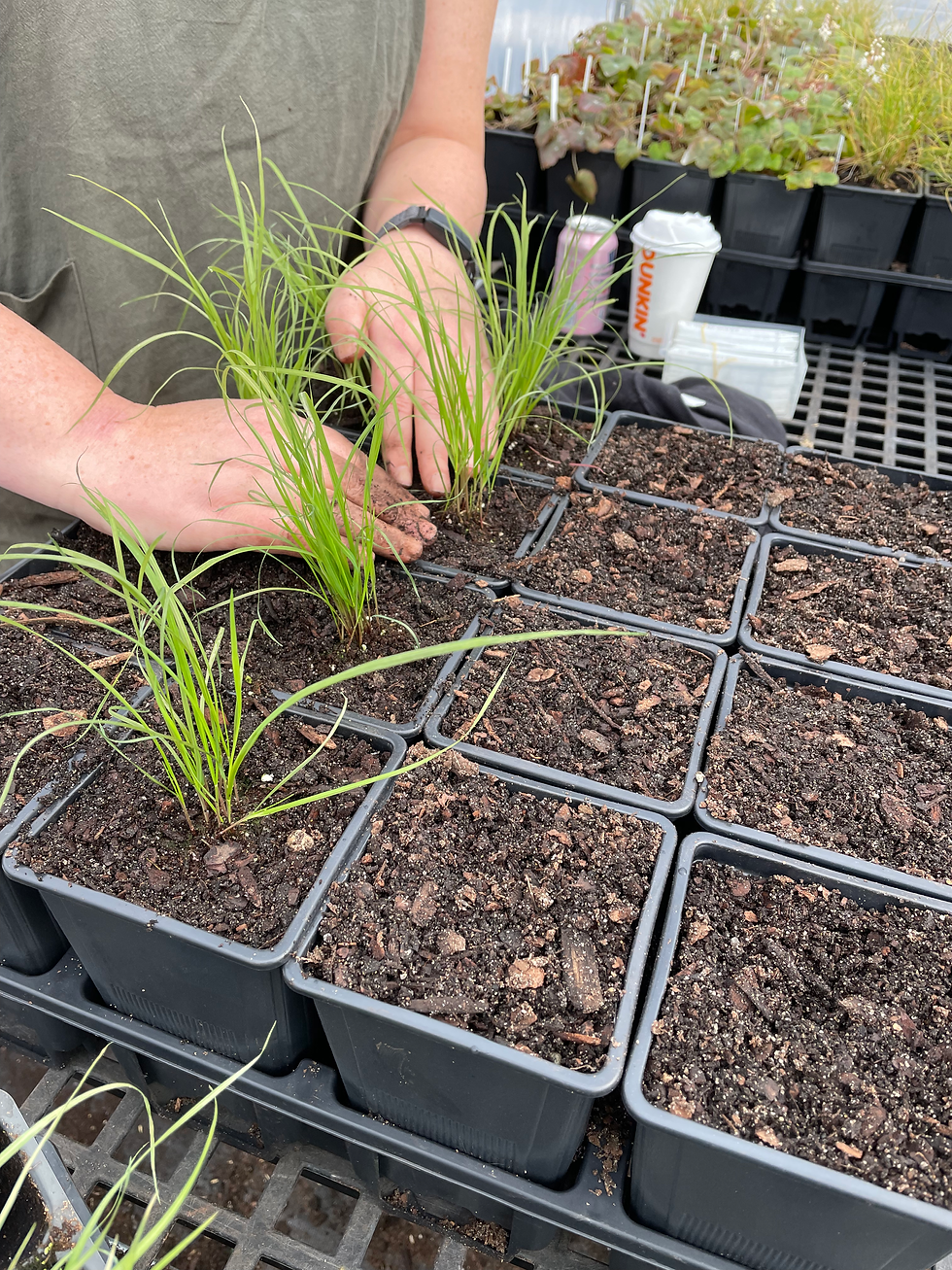
We do our best to avoid root-bound seedlings by moving plants into larger cells as soon as possible. If we see significant root circling, we gently loosen the roots before potting up—something as simple as a chopstick works surprisingly well. We don’t disturb the roots of native plants unless they’re actually root-bound.

As this Elymus moves into a quart pot, we keep the soil level exactly the same as it was in the cell. Planting too deeply can trap moisture around the crown and lead to rot, so maintaining the original soil line is key to keeping these plants healthy as they continue to grow.


Cutleaf coneflower grows so quickly that it’s one of the last species we sow in early spring. Its rapid growth rate means it doesn’t need an early start, and sowing later helps keep it from outgrowing our space too soon. We grow just one plant per pot because these plants get enormous, and if you’ve been to the nursery, you’ve definitely seen this towering species growing out front.

Ta da!


And that’s it—by mid-April, the plants are ready to start moving outside to harden off. This gradual transition helps prepare them for life in your garden, so by the time they head home with you, they’re well adapted and ready to thrive.


See you in the spring!

Britt


LOCATION

Located in Massachusetts • Serving New England gardeners

376 Washington Street
Norwell, MA 02061

Blue Stem Natives logo
  • Facebook
  • Instagram
  • YouTube

HOURS, MAY-OCTOBER

Tuesday - Friday: 10am-6pm

Saturday + Sunday: 10am-5pm

Get seasonal tips, native plant updates, and workshop announcements:

Thanks for submitting!

© 2025 Blue Stem Natives, LLC

bottom of page